

Mesh Face Orientation: Read the Manufacturing Scene Clearly
2026-11-04
Mesh Face Orientation: Read the Manufacturing Scene Clearly
Mesh face orientation can become a confusing subject in a manufacturing scene review. A shaded surface looks plausible, but another view highlights an unexpected side of a panel. The useful first question is what the display is showing. Face direction, shading information and a physical part's readiness for manufacture belong to different discussions. This practical reading uses Blender's official manual to help an editor describe the first two without inventing evidence about the third. No scene was executed or printed for this article.
Give the orientation question a specific subject
Begin with the object and region being discussed. A screenshot of a whole workcell may contain a demonstration part, surrounding equipment and explanatory shapes. An editor who writes that the model has reversed faces without identifying the relevant surface leaves the next reviewer guessing. Record the file revision, object name and view being examined, together with the reason that the orientation matters to the illustration or handover.
Consider a hypothetical illustration of a removable cover. A supplier says that one view shows the cover from outside. Before treating a highlighted region as an error, the reviewer needs to know which side the author intended to present and whether the cover is represented as a surface or as a volume. This is an example of a documentation question, not an observed defect in a delivered model. Preserve that distinction when asking for clarification.
Read the overlay as information about face sides
The official Blender Viewport Overlays documentation describes Face Orientation as highlighting face backsides in red. It says that red on the outside of a mesh generally suggests incorrect orientation. The qualified wording matters. The display supplies a direction cue that must be interpreted in the context of the intended surface, rather than an unconditional verdict about every red region.
Document which overlay is being discussed instead of relying on the appearance of a screenshot alone. A reader may otherwise confuse selection highlighting, material color or another display choice with the orientation cue. The manual also describes separate controls for viewing normals, including face normals and split normals. Those displays answer related but distinguishable questions. An orientation note should name the display actually used, if an observation has been collected.

Keep custom normals separate from face orientation
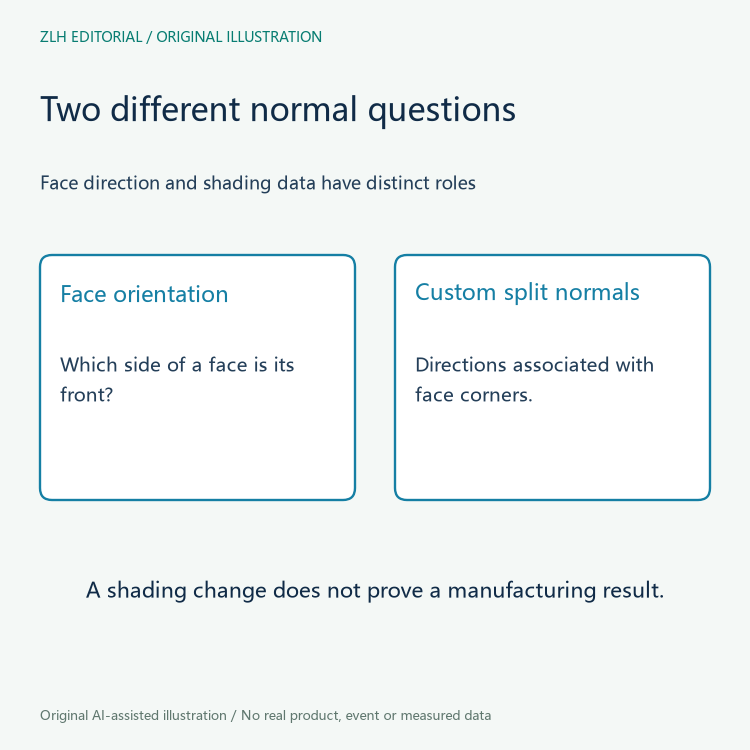
The official Editing Normals documentation explains that many operations in the normals menu concern custom split normals associated with face corners. It separately describes changing face orientation. In particular, its Flip and Recalculate descriptions state that those operations do not affect custom split normals. An editor should preserve that distinction rather than calling every difference a normal problem.
This distinction helps explain why a request such as fix the shading may be too vague for a handover. The author could be discussing how a surface is shaded, which side is considered its front, or both. Ask which property the requested correction concerns and what would demonstrate that the request has been addressed. A smooth-looking render does not establish that a separate orientation question has been answered.
The point here is to improve the reading note, not to prescribe an editing sequence. The manual contains tool instructions, but a manufacturing illustration review still needs its own authorized scope and preservation of the delivered source. A revised screenshot should not silently replace the only copy of the original geometry. Keep the original and the author's explanation available so that another reviewer can understand what changed.
Do not turn direction cues into a manufacturing verdict
Face orientation alone does not answer whether a proposed part has adequate thickness, represents the intended dimensions, or will meet an agreed manufacturing requirement. These are separate questions needing appropriate files, criteria and evidence. Neither of the two cited manual pages reports a print test or validates a manufacturing process. Describing an illustration as ready to manufacture would therefore exceed the evidence used in this article.
Even the manual's recalculation description notes that the mesh need not be a closed volume. That is a useful warning against treating the name of an editing operation as proof of closure. If a recipient needs a closed-volume assessment, the handover should explicitly identify that assessment and its result. A direction display can support an explanation of the scene while leaving other geometry checks unresolved.
Write a reading record that survives a revised view
A concise record should distinguish the source object, the display setting, the visible region and the interpretation proposed by the author. If the author supplies a revised scene, retain the relationship between the old question and the new response. An answer about a different object or camera view may be useful, but it does not automatically close the original issue. State whether the relevant region was actually reviewed or remains to be checked.
The linked manual URLs use Blender's latest documentation route, whose content can change. A detailed handover should therefore retain its access date and the version context used for the reading. Our two original conceptual illustrations contain no product geometry or measured result. Related material in the 3D manufacturing integration collection and the article directory can help frame additional review questions. The immediate outcome is a precise explanation of face direction, with broader production claims left to their own evidence.


