

Manufacturing Scene Acceptance: Identify Shared Mesh Data
2026-11-02
Manufacturing Scene Acceptance: Identify Shared Mesh Data
Shared mesh data can matter when a buyer accepts an editable manufacturing scene. Two visible objects may be positioned independently while still referring to the same underlying geometry. A promise that every depicted item can be revised separately therefore needs more explanation than a screenshot. This article proposes a document and scene-structure review for a fictional 3D manufacturing handover. It opens no model and makes no claim about a printed part.
Ask what independent revision is supposed to mean
Begin with the editing task the supplier promises to support. The buyer might need to move one illustrated item, change its geometry, or replace an entire assembly. These activities should not be merged under the word editable. Ask which changes are expected to remain local to one depicted item.
A useful delivery note identifies the objects involved and the data they use. Displayed object names can help navigation, but a different name is not by itself proof of independent geometry. The receiving team needs the actual sharing relationship rather than an inference from the object list.
Keep the hypothetical exercise bounded. The buyer can ask the supplier to explain the scene structure without requiring an invented demonstration. If an actual editing trial is later authorized, its starting file and observed scope should be recorded separately from this proposed checklist.
Distinguish a linked duplicate from a separate mesh
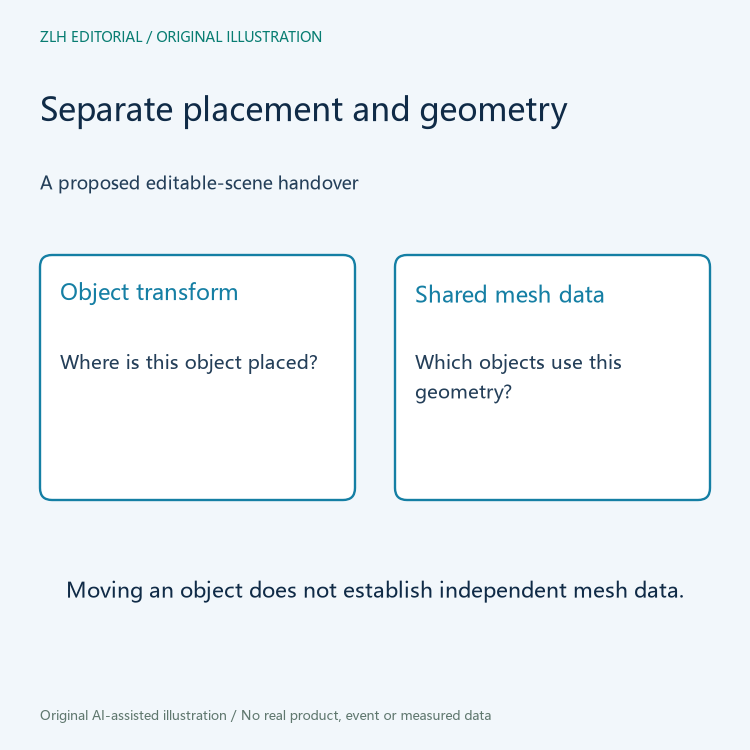
The Blender manual’s Duplicate Linked page explains that linked duplicates share data. Its mesh example shows separate objects using the same mesh, with Edit Mode changes affecting the linked copies. That is a specific relationship a supplier should identify in an editable-scene handover.
The same documentation distinguishes object transforms from that shared mesh relationship. Positioning one object does not, by itself, prove that its geometry has become independent. A supplier demonstration that merely moves an item therefore answers a different question from a demonstrated local geometry revision.
Ask the author whether sharing is intentional. Repeated elements can legitimately use shared data. The acceptance issue is whether that arrangement matches the promised editing task, not whether linked duplicates are inherently good or bad. The receiving instructions should make the consequence understandable.
Keep parenting separate from data sharing
The manual’s Object Relations page describes the Parent property and related parenting context. A parent relationship is another part of scene organization. It should not be used as an unexplained synonym for shared mesh data.
The buyer should ask two separate questions: which object relationships organize the scene, and which objects use the same underlying data? An answer about one should not silently close the other. A hierarchy visible in a screenshot cannot explain every data relationship inside the delivered file.
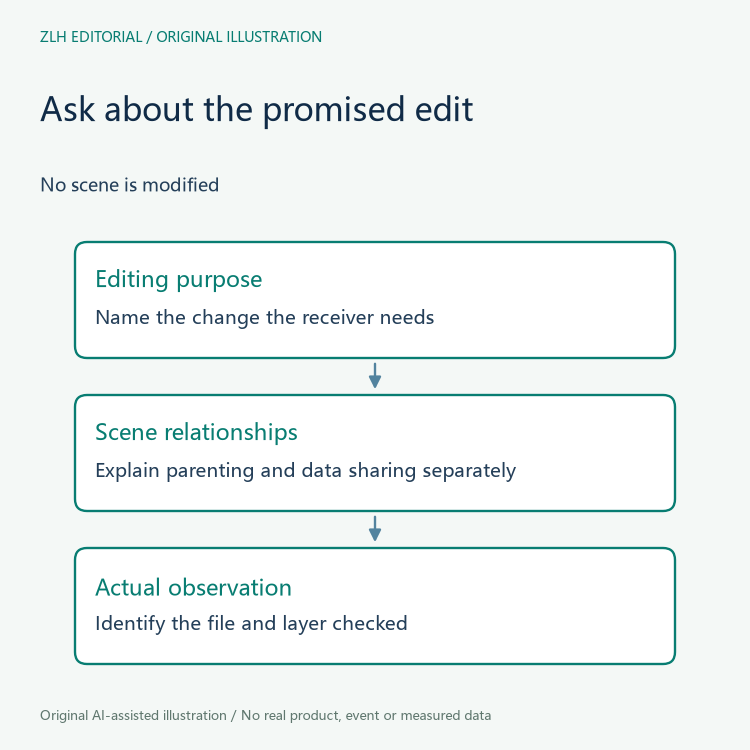
The current checklist does not change parenting, unlink data, or recommend destructive edits to a supplier’s original file. If the real handover requires a different arrangement, ask for a revised delivery with its changes documented. Preserve the original evidence rather than overwrite it during an informal review.
Request an editing account that identifies the changed layer
A later supplier demonstration should state whether it changed an object transform, mesh geometry, or another data block. The receiver then knows what the result actually demonstrates. A broad claim that the scene was tested leaves those distinctions unresolved.
If the supplier promises independent geometry changes, the review should identify the intended objects and observe the relevant relationship in the authorized test context. The demonstration should not substitute a newly constructed scene for the delivered material without saying so. That would change the acceptance object.
Equally, a geometry edit should not be treated as evidence about physical fit, collision behavior, process planning, or production quality. An illustration model can support communication without serving as validated manufacturing geometry. Those roles need their own agreed evidence.
Preserve the revision boundary in the handover
Ask the supplier to retain the scene revision and the explanation of intentional data sharing. If later changes make a shared element independent, identify what changed and which editing promises were rechecked. Old observations belong to the file on which they were made.
A receiving editor should be able to tell which changes are expected to propagate and which are intended to stay local. Unanswered questions can remain in the checklist until the author clarifies them. A neat object list should not be converted into a fictional acceptance result.
Related material is available in our 3D manufacturing section and the reading directory. The original illustrations explain relationships only. They contain no supplier mesh, rendered equipment, dimensional inspection, editing result, or completed production trial.


